Jesus Christ
God's Divine Plan for Salvation
The wages of sin is death (Rom. 6:23). Life is in the blood, and the blood atones for sin (Lev. 17:11). God the Father, who loves us, has not forsaken His children, and sent His only begotten Son, Jesus Christ, to become "incarnate“, and atone for our sins with His life and blood (John 3:16-18; Heb. 2:14-15).
Through the birth, crucifixion, resurrection, ascension and second coming of the Lord Jesus, God the Father has once and for all from redeemed His children from the dominion of sin and death, and restored us to God's presence and glory (2 Cor. 5:21; Heb. 9:12; 10:14). God's love for the world was thus revealed. You can read Jesus' Footsteps for details on this.
-
- Jesus’ Birth: Jesus was born to die. He came to the world as a man, so that mankind could be redeemed from the captivity of sin and death in Adam. (Phil. 2:6-8; Gal. 4:4-5; 1 Cor. 15:22)
- Jesus’ Crucifixion: Jesus died in our place as a substitute for our sins, so that God's holy justice and love could be fulfilled and we might become the righteousness of God in Him. (1 Peter 3:18; Heb. 10:10; 2 Cor. 5:21)
- Jesus’ Resurrection: Jesus conquered the power of death that Satan held over us, so that through Him mankind could have eternal life and regain the dominion lost by Adam’s fall. (Heb. 2:9,14,15; 1 John 3:8; Col. 2:15)
- Jesus’ Ascension: Jesus returned to God the Father in a glorified human body so that mankind could be reconciled to God and restored to the state God created in His own image. (2 Cor. 5:19; Col. 1:20; Phil. 3:21).
In God's redemptive plan for the world, Jesus' birth was for death, and Jesus' death was for the life for all! "as sin reigned in death, even so grace might reign through righteousness to eternal life through Jesus Christ our Lord." (Rom. 5:21) So that the world could be justified freely by faith through the redemption that is in Jesus Christ (Rom. 3:24; Eph. 1:7).

Birth of Jesus
Virgin Gave Birth to the Son of God
The name of Jesus in Hebrew means "Jehovah is Saviour/Lord saves", which foreshadows the identity and mission of Jesus - "Jesus Christ came into the world to save sinners". (1Tim. 1:15)
The Bible records that the virgin Mary was conceived by the Holy Spirit and gave birth to the Son of Man in a manger in Bethlehem (Luke 2:8-12; Matt. 1:20-23; Phil. 2:6-8). There were wise men from the East who followed the Star of Bethlehem to the birthplace of Jesus to worship Him. They presented the Child Jesus with three gifts: Gold, Frankincense and Myrrh (Matt. 2:1,11). You can also read Jesus Footsteps - Jesus' Birth.
In the Bible, “Gold" is the symbol of the divine, representing God’s glory, nature and majesty (Deut. 3:7; Exod. 25:31; Rev. 21:18). “Frankincense” is the symbol of holiness, representing the worship and prayer of God’s people. It was used by the priests for sacrifice and worship in the temple (Exod. 30:36; Rev. 8:3). “Myrrh” is the resin of a thorny tree, collected by wounding the tree to bleed. It means bitterness in Hebrew, and was used in ancient times to embalm the dead body, foreshadowing Jesus being wounded and crucified on the cross (John 19:39-40). The three gifts presented by the Wise Men point directly to Jesus' divinity (Son), identity (Priesthood) and mission (Sacrifice) (Eph. 5:2).
We can see from this that God the Father had a plan of salvation for mankind long before Jesus was born, and began to prepare the redemption of Jesus from the very beginning of His birth (Gal. 4:4-5). In fact, the Bible tells us that God planned salvation and ordained the death and resurrection of His Son before the creation of the world (1 Peter 1:18-20), and God even chose us before creation to be part of His eternal plan for mankind through His Son Jesus Christ: “He chose us in Him before the foundation of the world, that we should be holy and without blame before Him in love, having predestined us to adoption as sons by Jesus Christ to Himself…” (Eph. 1:3-5; Tit 1:1-2).

Crucifixion of Jesus
The Lamb of God’s Atonement
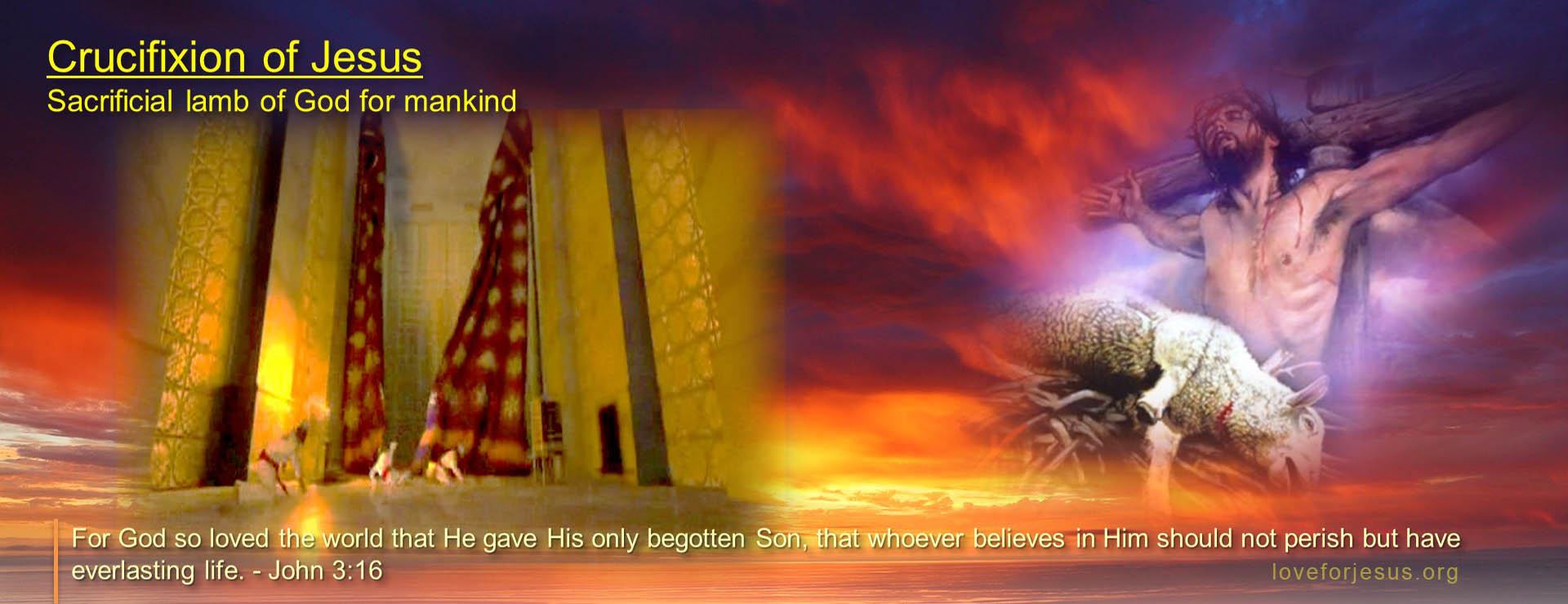
Holy God cannot tolerate sin. The wages of sin is death (Rom. 6:23; 1 Cor. 15:56). Life is in the blood, and the blood atones for sin (Lev 17:11). As “According to the law almost all things are purified with blood, and without shedding of blood there is no remission.” (Heb. 9:22).
In the Old Testament, before Jesus came to earth, God’s people offered "bulls and goats“ as blood sacrifice for their sins. But the blood of sacrificial animals could only cover sins, not take them away (Heb. 10:4). God so loved the world that He sent His Son Jesus in the flesh to be our scapegoat, and established a new covenant with the blood of Jesus (Heb. 9:12-15), so that through the redemption of Jesus Christ, we are justified by faith (Rom. 3:24; Eph. 1:7) and become a "new creation" in Christ (2 Cor. 5:17). Jesus is the Lamb of God (John 1:29). The animal sacrifice in the Old Testament was the picture of Jesus’ substitutionary death on the cross to atone for our sins. Please read the Crucifixion of Jesus for details, or see Via Dolorosa to follow the path Jesus walked to his crucifixion.
When the Lord Jesus said, "It is finished," before dying on the cross, the earth shook violently and the veil of the temple leading to the Holy of Holies was torn in two from top to bottom. The barrier of sin between God and man was removed forever. "Therefore, brethren, having boldness to enter the Holiest by the blood of Jesus, by a new and living way which He consecrated for us, through the veil, that is, His flesh." (Heb. 10:19-20). Please refer to Blood on the Mercy Seat for details.


Resurrection and Ascension
Jesus Conquered Sin and Death
Jesus came into the world as the Son of Man to give His life as a ransom for the world (Mark 10:45). After His resurrection, Jesus appeared to His disciples and others for 40 days (Acts 1:3; 1 Cor. 15:6), teaching them about the kingdom of heaven. Jesus told His disciples to wait in Jerusalem for the promised Helper and Comforter, the Holy Spirit, who would be with us always (John 16:7; Acts 1:4-5). Then, Jesus was taken up into heaven before His disciples in a way that was visible to all (Acts 1:11), and He will return to this world in the same way (Acts 1:11; Rev. 1:7).
Jesus, as the Son of Man, died in human flesh and rose from the dead (Acts 10:40), defeated the power of death, and took the keys of Hades (Rev. 1:18; 1 Cor. 15:56-57), so that mankind could be delivered from the sin and death inherited from the fallen Adam, and receive eternal life in the risen Jesus Christ (1 Cor. 15:20-22; 51-54; Heb. 2:14). If Jesus had not risen from the dead, we would still be living in sin (1 Cor. 15:17).
The risen Lord Jesus has been given all authority in heaven and on earth (Matt. 28:18). God the Father put all things under Jesus’ feet (Eph. 1:22). Jesus has returned to the Father as the Son of Man in a glorified body. He opens the way for humanity to return to the presence and glory of God the Father (John 14:6), restoring humanity's divinity and fulfilling God's original purpose in creating us in His own image. Please see Jesus' Crucifixion & Resurrection for details.


The Covenant of the Cross
New Covenant of the Blood of Jesus
Adam was called the son of God (Luke 3:38), and through his fall, the humanity suffers sin and death. Jesus is the Son of God, conceived by the Holy Spirit and became the "last Adam” (Matt. 1:18; John 1:14), so that the world could be saved through His atonement. "so that as sin reigned in death, even so grace might reign through righteousness to eternal life through Jesus Christ our Lord." (Rom. 5:21).
At the beginning of the world, God the Father caused the first Adam to fall into a deep sleep and made a wife for Adam from one of his ribs, so that she became the "bone of his bone and flesh of his flesh" (Gen. 2:21-23). God blessed Adam and Eve in holy matrimony. This foreshadowed the atonement of Jesus. God the Father had His Son Jesus Christ, the "last Adam", crucified and pierced in the ribs and shed "blood and water" (John 19:34) to redeem mankind. The blood atones for sin and the water gives life (Matt. 26:28; Rom. 3:25; John 4:14). Those who accept Jesus' salvation on the cross are "bone of His bone and flesh of His flesh" (Eph. 5:30) and are the "Bride of Christ”, betrothed to Jesus and looking forward to the "Marriage Supper of the Lamb" with Him at the appointed time of the Lord's return. Please see Covenant of Love on the Cross for details.
The Apostle Paul explains from a spiritual point of view that Jesus' love for the Church (those called in Christ) is beyond human comprehension (Eph. 3:18-19). Paul's metaphor of the relationship between Jesus and the Church as husband and wife is the great mystery of the Lord Jesus and the Bride of Christ, "For we are members of His body, of His flesh and of His bones" (Eph. 5:30-32). This is precisely what the Song of Solomon says, "My beloved is mine, and I am his." (Song 2:16). You can read more about this in the Lamb Wedding.